Kick Panels
There were 5 different panels for the Ford Maverick and 4 for the Mercury Comet.
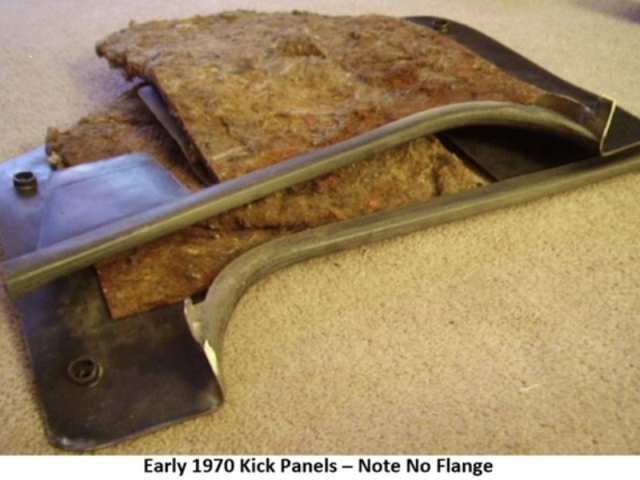
- Early 1970 Maverick (69.5) – (without flange, lower spacers on bottom of back side are approx.. 5/8” from bottom of panel and have the “flag”)
- Late 1970 - 1971 Ford Maverick and 1971 Mercury Comet – (with flange and screw hole spacers on bottom of back side approx.. 5/8” from bottom of panel and have the “flag”)
- 1972 to Mid-Year 1973 – (screw hole spacers on bottom of back side approx. 1 1/8” from bottom of panel and have the “flag”)
- From Mid-Year 1973 - 1975 – (screw hole spacers approx. 1 1/8” from bottom of back side of panel and have the “flag pole and no flag” due to glove box)
- 1976 – 1977 – (Drivers side kick panel appears more flat than all previous kick panels for foot clearance operating parking brake and had a few more angled cuts to go around foot operated parking brake mechanism. Passenger side is unchanged in shape from Mid-Year 1973 to 1977, Screw hole spacers approx. 1 1/8” from bottom of back side of panel and have the “flag pole and no flag” due to glove box.)
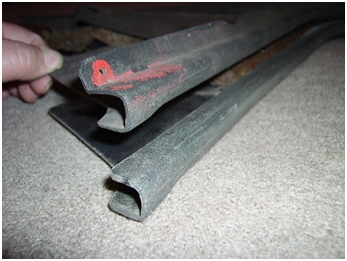
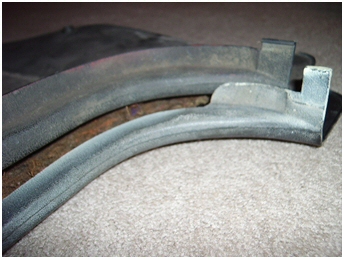
The difference between the early 70 and the late 1970 kick panels is the way the edge is mounted at the door jamb pinch weld, Early 1970 had no flange, Late 1970 had a flange, but no screw hole. In the photo below, you will see the pinch weld cover for the early 1970 on the bottom, was rounded with no flange versus a 1971 panel (w/ red paint) on top with a flange and screw hole to accept a screw. Late 1970 kick panels had a flange, but no screw hole. The late 1970 kick panel looked the same as the 1971 kick panel except for the added screw hole on the flange (Seen within the red paint in photo below). The flange remained until the end of production in 1977, however the screw hole was on some 1971 panels but not all, and were not present on the 1972 panels? From 1973 forward, all panels had this screw hole.
The kick panels for late 1970 to mid year 1973 all look the same in appearance.
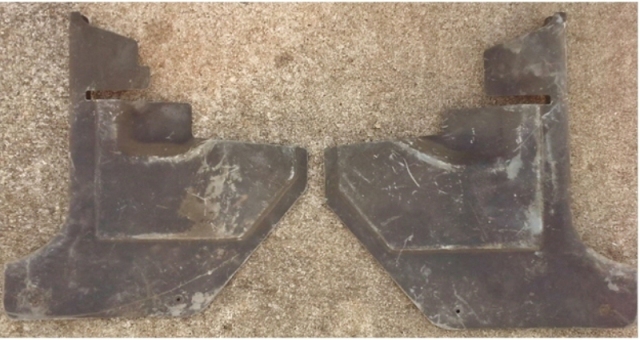
However one big difference was the location of the screw holes. The Early and Late 1970 to 1971 Maverick & 1971 Mercury Comet has the screw hole spacers are approximately 5/8” from the bottom of the panel.
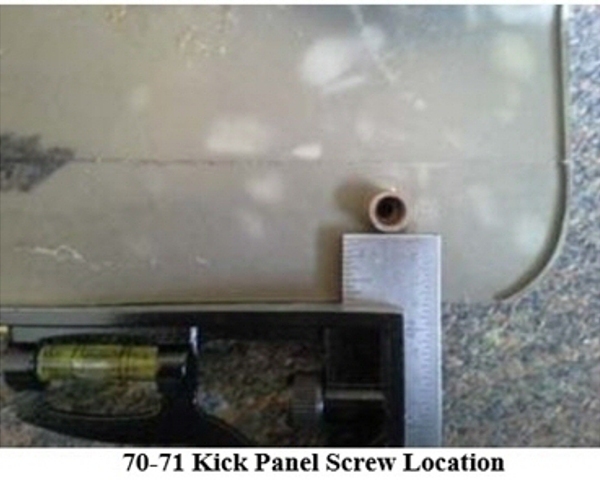
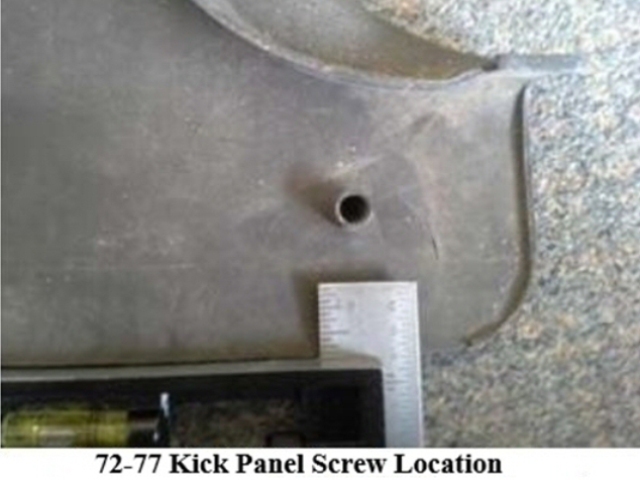
Beginning in 1972 and continuing to the end of the production run in 1977, the hole location was changed. Having the scale set to the screw hole spacers from the 70-71 panels above, you will notice the screw hole location is higher. These spacers measure approx. 1 1/8” from the bottom of the panel to the bottom of the hole spacer.
From mid year 1973 to 1975 the kick panels were the same in appearance. You will notice these have just the “stick” or “flag pole” (for lack of a better description) as opposed to earlier panels shown above which had the flag (again, for lack of a better description).
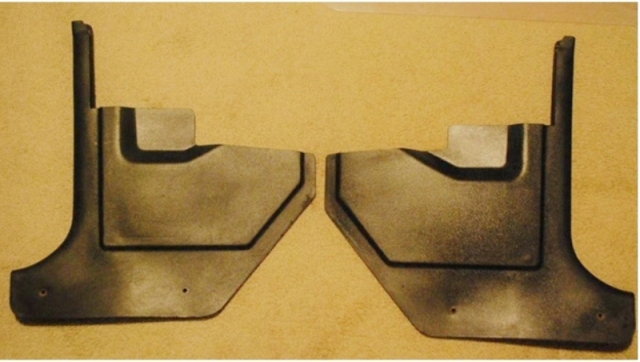
The reason for this change was from 1970 to Mid-Year 1973 all Mavericks and Comets came with a lower dash “package tray” and from Mid-Year 1973 to the end of the production runs for the 1977 Ford Maverick and Mercury Comet, they all had a lower dash glove box.
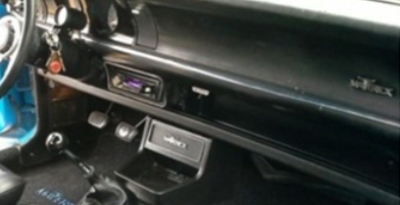
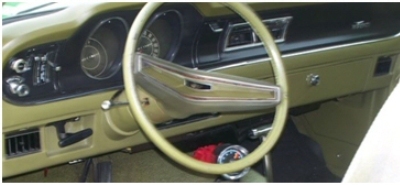
Beginning on the 1976 model, and continuing to the end of production in 1977, the parking brake moved from a hand operated dash mount to a foot operated parking brake, thus requiring another change. These were available with drilled holes and without drilled holes depending upon the sound system.
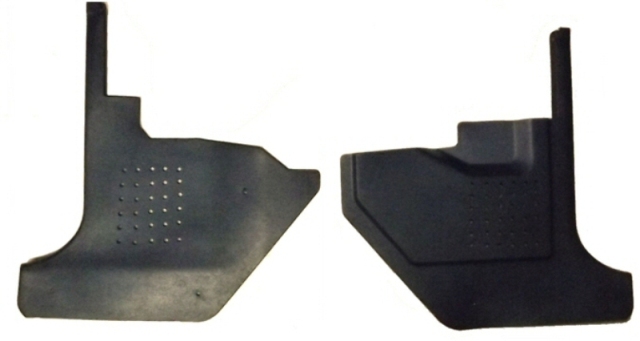
Next, I want to mention speaker grilles. As you see above, 76-77 models could be purchased with drilled holes and without drilled holes. Earlier, the panels were cutout at the factory to accept a small square speaker cover like those seen in Torino's’ and perhaps other Ford vehicles.
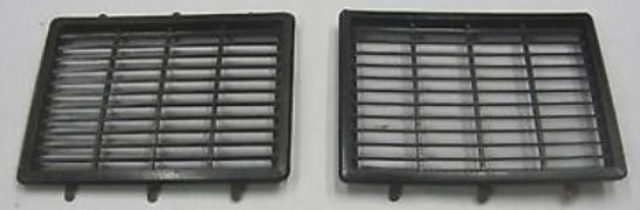
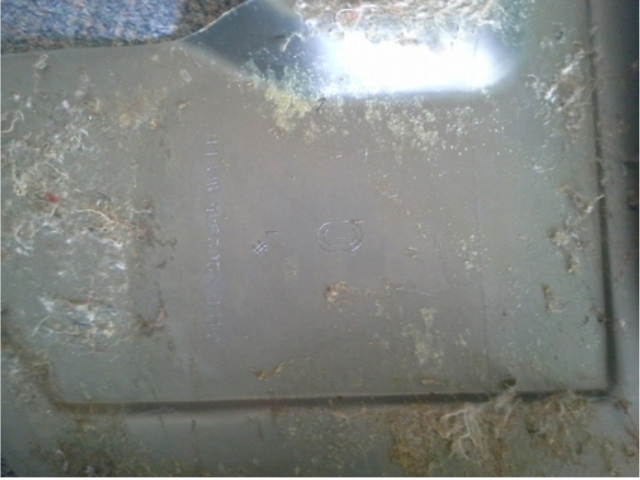
This seems to have been offered beginning in 1972, however not all panels were marked for this. As you will see on the back of a 1974 panel below, some panels were marked with a square and had raised bars for the hooks of the above pictured speaker grille covers to affix to. This type of back has been seen on some 1972 panels, but not all.
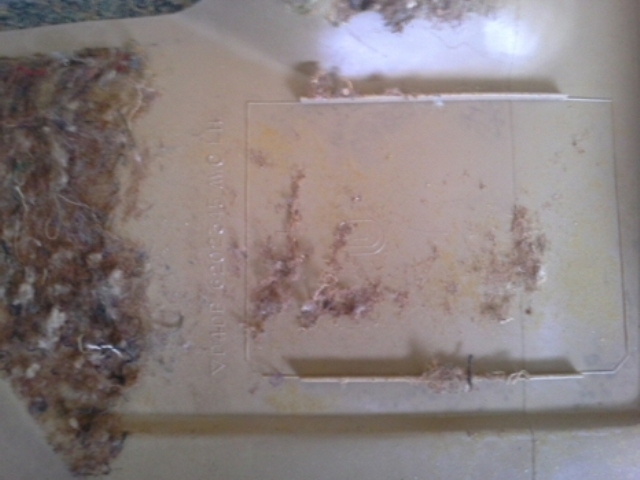
1970, 1971 and some 1972 kick panels had no marking for a speaker on the back side.